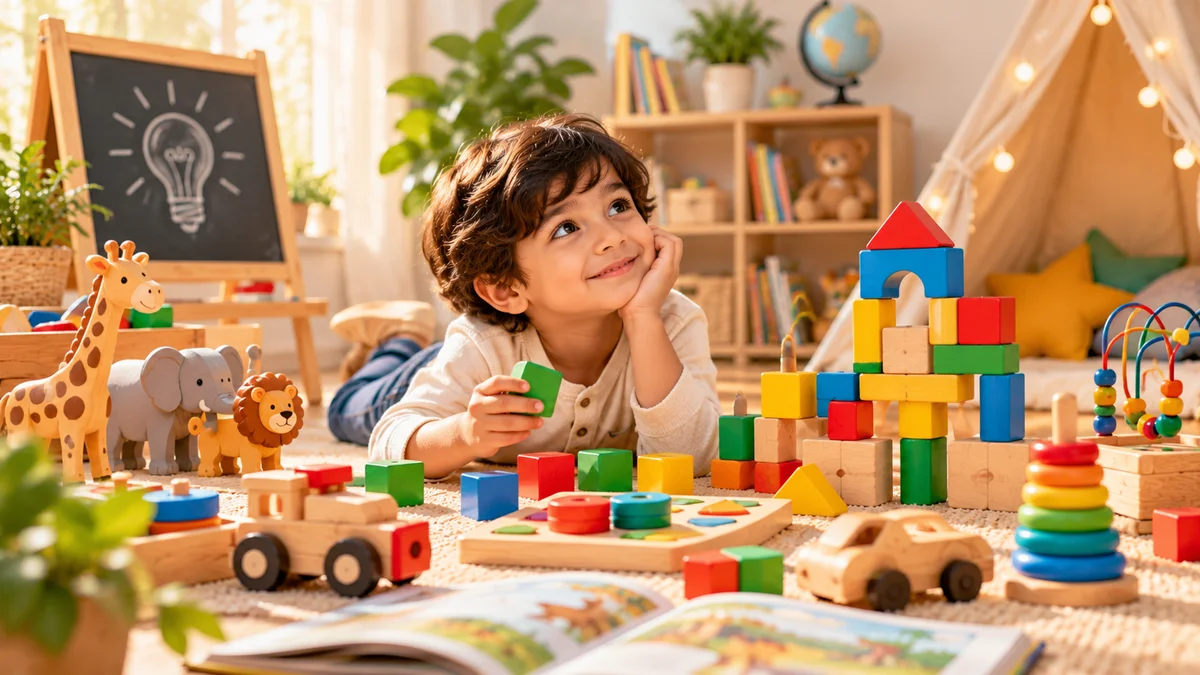
The Best Types of Toys for Curious Little Minds
The Best Types of Toys for Curious Little Minds
Category: Toy Guides
Author: Toyly World
Reading Time: 5 min
Children are naturally curious. They want to know how things work, what happens when they try something new and what they can create with the objects around them.
The right toys can give children opportunities to explore these questions through hands-on play.
A good toy doesn't have to be complicated. Simple toys that encourage children to build, sort, imagine, create and experiment can provide hours of meaningful play.
Here are some of the best types of toys for curious little minds.
1. Building and Construction Toys
Building toys give children the freedom to create something of their own.
Wooden blocks, building pieces and construction sets can become towers, houses, bridges, roads or completely imaginary creations.
While building, children can explore:
Balance
Size
Shape
Structure
Spatial awareness
Problem-solving
There is also no single correct way to build. Children can experiment with different ideas and learn from what happens.
2. Stacking Toys
Stacking toys are simple but offer many learning opportunities.
Children can stack pieces by size, color or shape and experiment with how different arrangements affect balance.
They can also create challenges such as building the tallest tower or making a structure that stays standing.
This type of play can encourage concentration, coordination, planning and problem-solving.
3. Puzzles
Puzzles encourage children to observe details and figure out how different pieces fit together.
When solving a puzzle, children may compare shapes, colors and patterns while searching for the right piece.
Completing a puzzle can also give children opportunities to practice patience and persistence.
Start with puzzles that match the child's age and gradually introduce more challenging designs as their skills develop.
4. Sorting and Matching Toys
Sorting toys encourage children to group objects based on characteristics such as color, shape, size or type.
For example, a child might separate red blocks from blue blocks or group large pieces together.
These activities can introduce early concepts related to:
Colors
Shapes
Numbers
Patterns
Classification
Comparison
Because children physically move and arrange the pieces, these concepts become part of an active play experience.
5. Pretend-Play Toys
Pretend play allows children to create their own stories and imaginary worlds.
Wooden vehicles, animal toys, play food, dolls and simple role-play sets can become part of countless adventures.
A small wooden car can become a race car.
A group of animal toys can become a jungle.
A few blocks can become a city.
Pretend play can encourage imagination, communication, storytelling and creative thinking.
6. Creative and Art Toys
Art and creative toys give children opportunities to express their ideas.
Drawing, coloring, painting and simple craft activities can encourage children to experiment with shapes, colors and patterns.
The focus doesn't need to be on creating something perfect.
The important part is giving children the freedom to make their own choices and explore their creativity.
7. Educational Games
Games can introduce learning concepts while keeping children engaged.
Simple educational games can involve:
Counting
Color recognition
Matching
Memory
Patterns
Shapes
Basic strategy
When children are having fun, they may naturally want to repeat the activity and explore new challenges.
8. Open-Ended Toys
Open-ended toys are especially useful for curious children because they don't have one fixed purpose.
A set of blocks can be used in many different ways.
One day they might become a tower. Another day they might become a garage or a castle.
This freedom encourages children to decide how they want to play rather than simply following one set of instructions.
How to Choose Toys for Curious Children
When choosing toys, consider whether the toy gives the child opportunities to do something, rather than simply watch something happen.
Look for toys that:
Encourage hands-on interaction
Offer different ways to play
Match the child's age and abilities
Encourage creativity
Develop problem-solving skills
Allow independent exploration
Can also be enjoyed with parents or friends
A simple toy that encourages exploration can often provide more creative possibilities than a toy with only one fixed way to play.
Why Simple Toys Can Be Powerful
Children don't always need more features, sounds or screens.
Sometimes a few colorful blocks can keep a child engaged because they can decide what those blocks become.
The child becomes part of the creative process.
They build something, change it, take it apart and build something new.
That freedom is what makes open-ended play so valuable.
Final Thoughts
Curious children need opportunities to explore the world around them.
Building toys, stacking toys, puzzles, sorting games, pretend-play sets and creative activities can all encourage children to ask questions, experiment and discover new possibilities.
At Toyly World, we believe toys should give children more opportunities to play, explore, create and learn.
Because every new creation can start with a simple question:
"What can I make with this?"
Explore Toyly World
Discover thoughtfully designed toys created to make everyday play more creative, engaging and meaningful.
Shop Toyly World →